
Many of us often feel that life has been unfair up to this point. We believe it has been unfair – at least in some areas of our lives.
We hunt for reasons in our past. Every struggle, late-night panic, we try to trace it backward to some event in the past, convinced totally that it all started somewhere back in time. And as extreme as it may feel, we even trace it back to the point of our birth – why was I born this way, in this body, in this family, in this society, in this culture, and on this planet?
In the same thought process, we continue, looking at others in comparison, and jealousy of the lives others have, and we don’t. The life we think we should already have it by now.
And still there is something else that also lingers; the quiet knowing of helplessness. We all know the past can’t be changed, what has been given to us – this body, childhood, past events they can’t be changed.
And we ask ourselves:
What if life were different? What if I were born different? What if things were different in the past?
We dance in this intricate dance of past, future, helplessness, and comparison with so many what-ifs.
Past Wounds, Future Desire, Helplessness, and Comparison
We look at our poverty and financial problems. Looking at poor parents – tired, stretched, did their best with what they had, and a quiet voice says: I was not born into generational wealth. If only I were born into a wealthy family, all these problems would never exist. All these struggles, scraping, fear for tomorrow, fear of pressure from others would simply vanish if only I had enough. And in the same very breath, we dream of the opposite: one day, I will have so much that all my problems will disappear. Life will be soft, safe, and problem-free. We look at Instagram reels – with people who have big houses, an apparent easy life, holidays, and a feeling rises in us. A sharp jealousy and a bit of anger, thinking: ‘If only things were different, I could have had that life.’
Someone who never quietly fit into any circle, group, or people. From childhood, he learned a clear message: you are the extra piece, the outcast. Now with every new room, every new group, the old wound opens again like clockwork. A small joke he does not get, a glance that slides past him, and the body remembers – almost tightening, aching, and crying without tears. He longs for a day when he will walk into a room, a friend group, where he will finally fit and finally belong. And meanwhile, he watches other people – giggling in loud, bright groups, and the ache becomes envy; if only I were different, if only I were born with a different personality, I could have that too.
A child raised in a house where love felt like a transaction, and the presence of parents felt conditional. Be good, be quiet, be like this, be a good student – and then maybe we will care for you and love you. Love was never simply given; it had to be earned, negotiated, begged. Some children beg for love with perfect grades. Some negotiate with perfect silence – ‘I will be a good little child, not messy, not clumsy, not childish, but quite a little boy so that it will be easy for you to love’. Love meant business – I will be like this, and then I will get care and love from you. He grew up with the wound of the past of never truly being loved unconditionally, never truly feeling the presence of another person unconditionally. Now the wound is old; buried deep, deep down – and it bleeds every time someone turns away, and affection feels measured. He carries a future fantasy now: ‘one day, I will meet someone who will accept me, see me, and be with me as I am. Love will not be a business; it will not be a negotiation. I will finally have a home, which is actually a home not a battlefield. ’ And everywhere he sees people who he thinks have grown up wrapped in steady, unquestioned love – and the comparison is merciless. He thinks: if only my childhood had been like that, if only I had been given what they were given, I would not still be starving for something so basic.
To some, life keeps withholding the one steady relationship they were promised by culture, by every movie, every song in their childhood. Now looking back, every past relationship has left a scar – betrayal, abandonment, hurt. And now the wound says; you are the kind of person people leave. So a desire has grown deep; one day, somewhere, someone will choose me and stay. Someone will finally break the pattern. And he walks past couples holding hands, celebrating anniversaries, building families, and the knife turns again: if only I had been different, if only I had a different personality, if only the choices I made or the choices others made were different, then life would have been different.
Underneath all these stories runs the same current: we long for love that is unconditional, to be seen, to be admired, to be appreciated. Because there is a wounded heart that feels – love is a basic, like air that we breathe, but I have to do business for it. And sometimes it feels like grasping for air. We look around constantly comparing ourselves to others – in jealousy, of the life that was denied to us by our past, by our parents, by our lovers, by our friends, by our personality, by our own skin, and ultimately by life itself.
So we feel: Life has been unfair. If only I were different, if only my parents were different, if only the people I am attracted to were different, then things would have been different.
Now we sit, perfectly knowing the past can’t be changed in a helpless state of thousands of if-onlys, what-ifs.
Grief: Between Past and Present with No Future
The future we desire is the reflection of the wound that we carry from the past. The longing for that one thing is simply the shape of the hole that was left inside of us. Desire is the fantasy we keep polishing: if I get that finally (money, love, belonging, beauty, health), then life will be at last perfect, then the ache will stop. Some of these pursuits look achievable, even realistic (unlimited money, power, status), and we can spend an entire lifetime chasing them without ever seeing that we are only trying to fill an old, bleeding wound.
But sometimes life gives us wounds of a different kind. The kind with which life removes the possibility of ever finding the one thing in the future that could have dissolved the pain. The imaginary future that we can chase: if we achieve it can heal our wound, also gets taken away by life.
Take the example of belonging or fitting in. You can chase your whole life trying to perfectly fit in. But the more you chase, you realize that almost always, to fit in, you have to compromise a part of yourself. All belonging to society; to culture; to groups is only valid as long as you follow the agreed rules of the society or culture or the agreed acceptable behavior of the group. And as you keep on chasing, you come to the helplessness and realization that: I am never going to fit in or belong ever, it is not possible.
You are born into a body that others call unattractive, or you get chronically sick, or you are born with disability at birth. There is no changing that, is it? There is no coming back from it. There is nothing really to chase anymore, as if life has been so cruel that it told, take this and deal with this. Every mirror, every glance, every rejection, every closed door reminds you of the body that you are born into. So you sit with this helplessness, almost mourning of the body that you are born into.
You lose someone you loved – a parent, a sibling, a partner, a friend, you thought you had more years with. A whole chapter of life shut down half-written. So many things left unsaid, so many things left unexplored. You wait for a closure that will never arrive, that can never arrive. The hope of possibility has been taken away by death itself. So all that is left is this present moment of mourning in helplessness.
Then there is the deepest and most universal wound of all: the wound of love. The word itself is so ambiguous. We have been told from the day we were born that love is something you find outside yourself. In another person, in their eyes, in their arms, in their words, and in their staying. Movies, songs, poems, all whisper the same promise. So the wounded lover tries everything. He learns to be funnier, smarter, quieter, louder, successful, and spiritual, just to become the kind of person someone will finally love. Every time he falls in love again, he thinks this time the wound will heal, but it never really does. He tries harder, he tries less. He says he is working on himself, tries dating apps, therapy, silences, parties, meditation retreats, and new cities. He tries to let go ( because someone told him love will come when you stop chasing), but only to realize now he is chasing to let go. Years and years of running around, and finally, something starts to become clear: The future possibility of love may never arrive. So what remains is that he walks as if he is mourning in helplessness of never truly finding what he really desires.
This is the space of grief: a stream from the past to the present, with absolutely no possibility of anything in the future coming to heal the wounds of the past. This is the grief – the helplessness and a silent mourning of your whole body.
Unprocessed Grief: Being Stuck
A real sign of grieving body and mind is: you feel stuck in time, as if everything and everyone is moving on, and you are there, standing alone, with almost a total incapacity to move forward. You are frozen in time. You feel this in your body – that you simply don’t want to do anything, don’t want to take any action. Logically, you see that you should do this, do that – that will be good for you, but your body betrays you.
Unfortunately, the world looks at these adults and calls them ugly names: lazy, afraid, fearful, anxious, traumatized, indecisive, and toxic. Men are told to: just man up, stop being soft, stop crying, and fix yourself. Women are told; You are too much, too emotional, too sensitive, just move on, and think about your future. But nobody sees that it’s just a helpless child, stuck in time, never really got a space that felt safe enough to grieve.
That is why some of us overthink every tiny thing until our own mind is a prison.
Some of us get sick and quietly refuse to heal our bodies, thinking Why keep fixing this thing that was never right to begin with? Why do I only keep falling sick?
Some of us gain extra weight and keep eating unhealthy food, but can never truly wake up every morning to go to the gym or run. Because there is something still mourning for an unknown wound that we can’t put our finger on.
Society will keep labeling them names, and self-help will keep selling ten-step programs. But an adult who can’t move on is not a lazy one; it’s a grieving child frozen in time. So never take these names, labels, seriously. And I hope one day you find a place safe enough for you to fall.
The Fall
So what to do? When the future is gone, and the wound is all that remains. Nothing we can do.
Life wants you to mourn, and grieve, so you grieve. What else can you truly do?
Fall into that abyss of grief, really, really fall into it. You are already falling; you are simply not acknowledging it. How long can you really hold on to strands of grass when you are drowning?
Fall because until you actually fall into it, you really have no idea what you are mourning. You only know stories about it, and faint glimpses of it in day-to-day anxiety, panic attacks, and bodily triggers of yours. You really don’t know what your grief is until you go all in. You have to go all in to see the shape of what was never given, and what can never return anymore.
Every time you truly witness it, encounter it, you will come back lighter into this moment. You will come back with a little less desire for the future and a little less longing for a different past. You will come back to this very moment, empty.
The Finding
In this space of grieving, what you find is forgiveness. Forgiveness for the parents that you actually needed, forgiveness of the lover that hurt you, forgiveness for the friend that betrayed you, forgiveness for life that feels unfair to you. And you don’t forgive because it is the morally right thing to do, or you are some good, bigger person who forgives. You forgive because you see that the wounds have been weighing you down. You have been carrying stones in a backpack of your wounds that life has been feeling so heavy as far as you can remember now. So you forgive, not an action, but simply by seeing that you no longer need to carry the past to this moment. This makes you feel lighter.
Another thing that happens is that you stop comparing yourself with others, too. We compare with others not because we are jealous or angry. We almost always do because we look at them and feel the life and experience that was denied to us. The parents who made you believe that love is conditional, and the adult who looks at others with a stable relationship, and is jealous of them because it was a possibility for you too, if the past could have been different. The parent who made you feel worthless, and now you, as an adult, keep looking at how much other people simply live life normally and feel worthy, enough, and chosen. But you have been running your whole life and never has someone looked at you like you are worthy enough, and so you feel jealous, you compare yourself. The more you fall into grief, the comparison stops on its own, not because you are better in some way, but because it’s too tiring to keep looking at others and judging yourself continuously.
And perhaps the most beautiful thing that happens in grief is that you stop wishing for the life to be any different. Not because you have healed in any regular sense. But because you see that, to dwell in what life could have been if things were different is to deny you the life that is happening right now – in this very moment. Have you not seen that when you are dwelling in the past, you miss the sunlight on your face, you miss the dancing trees around you, you miss the smiles of strangers. You miss so much, you miss this moment that is precious. In this, you become a bit more alive.
So fall, and keep falling. The fall will not be a one-time event; it will be cyclical. You will keep rising from the fall a bit lighter, and again, the grief will call you back. You will go through this again and again. They say a spiritual awakening is 1000 deaths and rebirth. And this will be that, every time you fall into the grief: the past and future die in you, and every time you come back from it, you are more alive in this very moment.
The Womb
So grieve so deeply if it comes to you that let the universe hear your screams. Fall into that nothingness of grief.
The first fall will be the most terrifying because you don’t know if you will ever survive it. It is like you going into deep water, without knowing how to swim, with no one around, with a certain possibility of death. And yes, something dies, but what dies is not really you. What dies is the wounds of the past and desires of the future. And every time you come back alive, next time when you fall again, you are more trustful, and more fearless.
And you will see that when you really fall, something catches you. Not the stories of childhood, not the promises and words of lovers, not the words, not the thoughts, not the philosophies, not the psychology of the therapists, not the praises, not consolations, not sympathy. What you really fall into is the mother that is the universe, the lover that is life, and an infinite source of safety and security that has always been there with you, untouched by your trauma and wounds of your past.
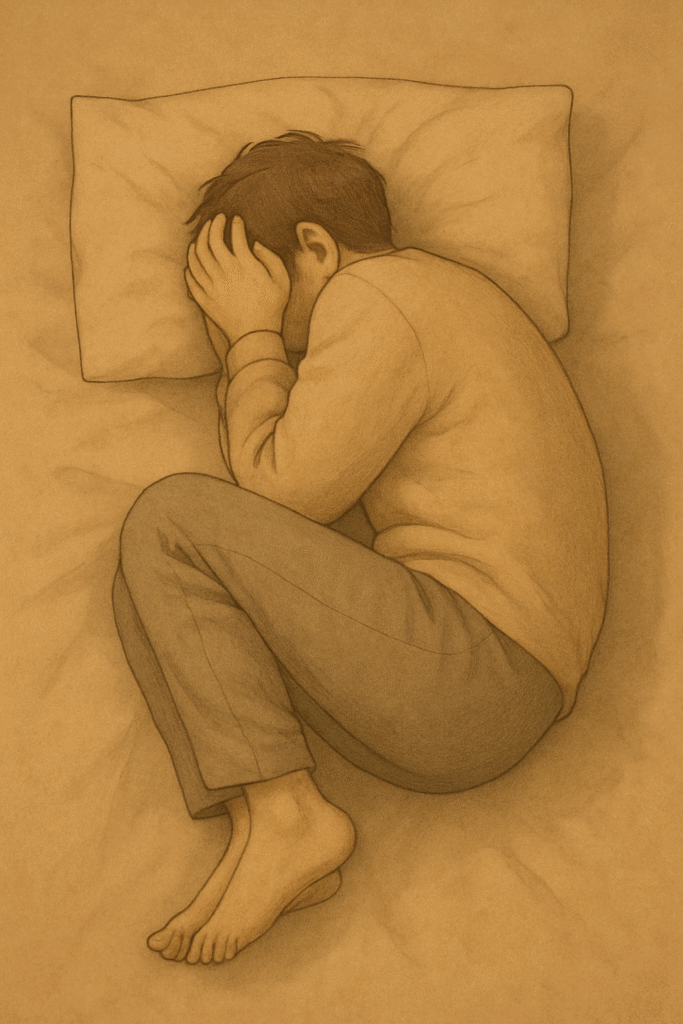
It might sound mystical, but you almost always fall back to grieve like this in your bed, crying, like a fetus in the womb of a mother. This is the womb of motherly life that you go back to, for you are truly in the process of rebirth.
Leave a Reply