Creativity, something I keep coming back to over the last few years, again and again. From my own experience, I can say that almost all mental health issues, neurosis, overthinking, anxiety, and emotional pain I have ever faced have come from my inability to create. Slowly but surely, the words of Osho that I heard a few years ago still ring true in my ears:
“Creativity is the greatest rebellion in existence.” —Osho
But the word “creativity” must be truly understood. What is creativity, and what is not?
Creativity
We all know that now AI tools like ChatGPT can create images and paintings. But do you know how it creates them? It creates an image by mixing. It has a big database of images — maybe a billion images. The AI company first assigned manual labour to label these images. So someone sits and writes: this is green colour, this image is a tree, this image is a child. Like this, millions and millions of images are labelled. Now, when you write “Give me an image of a small child sitting near a tree at a park with an oil painting,” it simply mixes images from its database and gives an image.
Would you call this creativity, or would you call this data processing? Would you call a factory producing 100 cars per day creativity or manufacturing?
Obviously not – we would say. It is simply data processing or manufacturing.
Now let’s talk about us – we humans. If you tell someone to draw a picture of a tree, they recall a memory of what a tree looks like, and they paint the tree. Would you call this creativity or data processing?
If you tell someone to write a poem about love, they draw lines from all the books they have read about love and write a poem by mixing ideas and lines. Would you call this creativity or data processing?
I would call it data processing, although many people who call themselves creative are data processors, not creative. We use our old training (school, college, books, music, ideas about what life is, ideas about who we are) and we create. We write poems, we make movies, we make art, we make music, and so on. Unfortunately, this is not the creativity I speak of in this post. This is, for me, data processing. And data processing is not creativity.
It might sound harsh, and it is. But creating out of our mind by using old data is not creativity, but data processing. It does not bring any revolution in your own life.
The definition of creativity that I will give is something more radical. Creativity is an act, any act. It can be as simple as cutting grass or making music that comes out of you in a spontaneous manner. Creativity has a taste of your own being, your silence, your nothingness. Creativity is something that feels like something simply wants to move through you and express itself. Something that is not in your control, not in your planning, not in your imagination. Something that grows out of you like a tree comes out from a seed.
This is why the first thing to realise is that as a human society, we are not that creative. Life is very creative. Every human body looks different, unique; every fingerprint is unique; every tree is different, and every leaf of a tree is unique. Such is the uniqueness and creativity of life. But look at us humans: we follow the same religion that we have been following for 1000s of years, most of the movies look the same, many novels are remixes of each other, many songs are copies of each other. We are not unique individuals, but we are personalities and herds that we call society. So we are not creative, and in this, we have given up our birthright and aliveness that is creativity.
Now, let’s understand the key blockages that do not let us create.
The Race
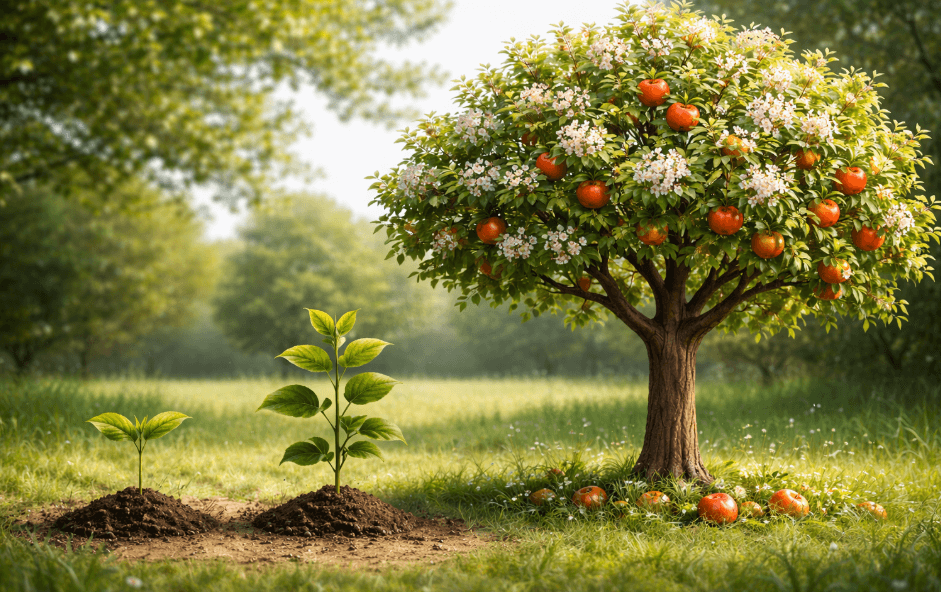
If you look at these three: a sapling, a plant and a full-grown tree, can you say who is more creative or who is less creative? Most people would say the full-grown tree is more creative because it has flowers and fruits. It sounds simple and straightforward. Yet if you really look at it, you will find that all of them are creative. All of them have put their total energy into growing to whatever possibilities they can be.
The reason we assume that the big tree is more creative than the others is that our mental conditioning of life is about winning a race, and to most of us the big tree has won the race of life by putting forth fruits and flowers.
From our childhood, we have been taught to race. In school, everything is a race: classes, exams, sports, everything is about winning or reaching a goal-post, a destination, then only we say yes, we have done something. Children of the school grow to become adults. They find the whole society is made up of races. Everything is a race: from status, money, looks, power, dating, art, music, and science. Everything is about reaching somewhere.
So why can’t a person who is in a race be creative? Because anyone who is trying to win a race in life, any race, their main goal is not to create this moment; their main goal is to go to a destination where they feel they are on top of others. Think about those three: the sapling, the plant and the tree.
Is the sapling fantasising about becoming a tree with flowers and fruits? Truly, it does not know anything about what its flowers and fruits would look like if it were to grow. Is the small plant imagining how it’s going to be when it grows up? They don’t because they are not of a race. What they instead do is put their total energy into collecting minerals and water from the soil and work as best as they can into growing themselves. And this process is creativity.
The first blockage is competition. If you are in competition, any kind of competition, you can’t be creative. The more you are running in races of society and culture, the less creative you are.
Perfectionism
Two children were making drawings in a class. One of them used to go to painting class, and the other was drawing for the first time. They both drew, and the one who went to painting class produced a nice, proper drawing, while the other kid did a good enough job; he simply drew something that he thought was a tree. After a while, the teacher came, looked at the two drawings, praised the one who drew properly, and told the other child to learn from it. And from that day on, the child is still looking at others’ drawings, wondering if he is doing it correctly, if he has enough expertise or knowledge to actually draw anything.
But to me, the second child, who drew something good enough for the first time, is far more creative than the one who simply did what he learned in painting class. Because the first child was spontaneous, and the second was data processing.
We have been deeply, deeply programmed from childhood that if only you can be an expert at something, then only you can create. If only you are knowledgeable at something, then only you can express or speak up. We are told that first become perfect, and then you can create. That is why so many young, creative people spend years researching, learning, and reading endlessly rather than expressing themselves.
Back to those three: the sapling, the plant and the tree. None of them is perfect, none of them knows if they are doing it 100% correct, none of them knows if they are going to be alive the next day. Yet they create based on whatever they have in this moment. The truth is, because they really don’t know if they are correct, they create. They create something unique, something beautiful, something random. If you are 100% certain or perfect, you can’t create anything unique. In fact, this is the basis of creativity in life: a space where you know, but you don’t know also. Both are true at the same time.
Years I used to think: if I become perfect enough, I will write more, write my blog, do more. And that seems like a false assumption as I look back. I keep wasting so much time not creating. Because, as I trace back now, years ago, there were things I was sure of and there were things I was not sure of. And today also it holds the same truth; there are things I am certain of, and there are things I am not certain of. It is the uncertainty that gives rough edges, doubts, chaos, and mess to whatever I create, and it is the certainty that gives direction and clarity to whatever I create. And without the chaos and clarity, it is not possible to create.
Consumption Culture
Take the day-to-day life of a general urban or city, the life of a working person.
Let’s take the weekend.
He wakes up, scrolls on Instagram for 15-20 minutes. Consuming content.
After some time, he eats breakfast. Consuming food.
It is the weekend, so it is time to relax. So let’s watch a Netflix TV show. Again, consuming entertainment.
Then have lunch. Consuming food.
Now he has a plan to visit a museum with a friend. Consuming knowledge.
Then in the evening he goes for a walk. Puts on some music. Consuming sound.
Then in the evening he plans to socialise with friends over dinner. Consuming food and drinks.
Then he goes to a bar to socialise more. Again, consuming drinks.
After coming home at night, he realises there was a football match going on. So he turns on the TV. Consuming sports.
I might have exaggerated the day, but the point is that the whole culture is consumption-based. Food, drinks, entertainment, music, reels, TV shows, movies, alcohol, knowledge, sports. Nowadays, there is a big industry and trend that is travelling around. But you see, travelling is nothing but consuming natural scenery or new places through your eyes. Think of it this way: anything that goes into us via the mouth, eyes, and ears is energetically going inside of us. We are consuming it.
It would seem that we have such a deep void within us that we keep on stuffing ourselves with everything. And this is the culture in the whole planet. This very culture is against any kind of creativity.
I am not saying consumption is bad. Consumption is pleasurable, but the addiction to consumption is against creativity.
No – Creativity: A Poison
If you look up on the internet, you will find this to be true. Extremely creative people have a higher tendency to be addicted, suicidal, emotionally unhealthy, and feel lonely. You will find that creative people suffer a lot more in life.
It is because creative people embody more energy, a higher level of energy in their bodies. This higher level of energy in the body makes them more alive, more sensitive to life around them. And it is the same energy or life-force that is supposed to be used for growth and creativity. Creativity happens when that energy flows in their body and mind without any blockage.
Here is an example of how sensitive creative people are:
Ustad Nusrat Fateh Ali Khan is by many regarded as the greatest musician of all time. He is known as the King of Qawwali, a devotional Sufi traditional music. When he was recording a song — there were a few lines about where a father is remembering his daughter’s childhood, as she grew up. The song is set during the daughter’s marriage; after which she will go live with his husband, leaving the father alone. And Ustad had a small daughter of his own. During the recording of those lines, he cried around 150 times, as remembered by the music director. The story goes like this: the music director said let’s do it tomorrow, but Nusrat ji said, “It will be either done today, or it will never finish. A fever of grief and pain that has come with this. This song will either happen today or it will never happen”. And he said whenever he is singing this, he starts thinking about his daughter.
This is the level of sensitivity and energy creative people hold. Now, think about this: what if a creative person somehow can’t create? What if they are blocked by something in their life that does not let them create? That energy, which was supposed to be used for creativity or growth, now turns the body and mind into a battleground. This battleground feels like emotional pain, addiction, internal struggle, neurosis, and extreme overthinking. That is why the energy that can’t be creative is a poison.
When the energy does not find natural, effortless expression, it finds expression through unnatural ways, compulsive ways. Because when the energy can’t express itself, it feels like a void or emptiness in you. That emptiness void feels like loneliness, and that gives rise to an extreme level of emotional pain and addictive behaviours. In my later posts, I will cover these tendencies in detail, but here are just a few ways it shows up in life briefly.
Many people try to fill that emptiness or void with outside things — like movies, tv shows, or information. For example, think of a time you started binge-watching a TV show. You enjoy initially, but at a point comes you stop enjoying. You are watching simply because you can’t stop watching. The more you continue, the more you feel hollow and hollow.
Another way the unexpressed energy starts expressing in unhealthy ways is by making your mind extremely hyperactive. This leads to over-thinking, anxiety, neurosis and many mental health issues.
Another big way the unexpressed energy behaves is by distorting your sexuality. It is because creativity is deeply, deeply related to sexuality. The more creative you are the more sexual you are. The unexpressed energy goes into compulsive sexual tendencies and fantasies.
Many creative people get stuck in this loop of addiction, neurosis, emotional pain, and unhealthy sexuality, because the energy that wants to find a natural way of expressing itself in your own life can’t be expressed. So the gift of creativity is a double-edged sword. If you are not creative with that energy, it will become poison.
How to be creative?
The more creative you become the more you will feel full by your own energy. There will be a real feeling of fullness in your own body by your own energy. Many times I have experienced this; I would keep feeling empty, and when I started doing something creative, I would have this feeling of fullness in my body. So the only real way to feel full is to be creative in life.
Now, a question arises after this: how to be creative? But you see, behind this question, there is an assumption that we are not creative by nature. And this assumption is not totally correct. You see, the sapling, plant and tree are creative by simply existing. So are we. We are creative by nature.
So the real questions are:
What is blocking my creativity?
What would I like to express in the outside world that I don’t think will ever be possible to do so?
What are the things I think about in day-to-day life that make me think I can’t express myself spontaneously as I am?
Where are the spaces in my life where I am creative?
Where are the spaces in my life where I feel full of my own energy, full in my own body rather than empty?
I remembered that as a teenager, I used to solve math problems that could have been solved by the usual method. But I would always try to do things by myself without looking at the book, and I would most of the time come up to the solution with a twisted, unusual method. Teachers would repeatedly tell me why do you have to do it this way? There is a simple way to do this. Looking back now, I realised the real joy was not about the solution but about the rediscovery of something that I never knew. And we all kids have something like that in childhood in some areas of life. But we have been told and taught again and again to win in a race, not express ourselves.
I think that is what creativity is, a spontaneous expression of our life energy in any moment. We assume that creativity is limited only to art, music, or literature. But creativity can be at any moment. I am finding you can be creative at cooking, at cleaning your home, at writing, at friendships, at conversations, and at day-to-day living.
Creativity is the greatest rebellion in this society, because everything is designed for you not to be creative. Everything is designed for you to keep consuming. Consume movies, TV shows, food, books, reels, drinks, sports and so on. From morning to evening, consume and work a 9-5, barely a creative job. In fact, society is made in such a way that you get addicted to consumption and non-creative work, and that keeps you depressed, empty and hollow from inside.
I have found that whatever we do for the sake of doing it, with no goal, becomes a creative process of its own. And that would be the greatest rebellion against a system that keeps you less creative.
Leave a Reply