Understanding and Moving Beyond Addiction to Consumption
Contrary to popular belief, the inner work to break free from addiction to consumption does not require forcing yourself to express, or fighting with yourself. However, it does require you to start paying attention to yourself, a fundamental shift in your mindset, and a re-examination of your beliefs about life. Surprisingly, most of this work involves working directly with your physical body. This post explores the inner work, practical steps, and the philosophy behind the journey toward health and harmony beyond the addiction to consumption.
The Vision
One key thing has to be realised if you are addicted to consumption: you derive pleasure from consuming while expressing feels painful, uncomfortable or exhausting. The key word here is pleasure.
Think of a time when you have two choices. Either you can spend some time watching a TV show, or you can do something expressive like maybe painting or working on your side project. And if you almost always choose to consume rather than express, it is because you find the consumption effortless and pleasurable. While you might find doing something expressive or working exhausting. This is the central problem: you have become incapable of deriving pleasure from expression and creativity.
The way most self-help content out there deals with this problem is by condemning your capacity to derive pleasure from consumption. They attack your natural capacity to derive pleasure from consumption. They tell you that it is wrong to watch TV shows and enjoy; it is wrong to watch reels and enjoy; it is wrong to eat tasty food. They give you tricks to run away from this pleasure. They tell you to go on a dopamine detox, lock down your phones, and throw away your sugar. This is the wrong way, in fact, a self-harming way. Let me show you how.
This is a very clever trick of mainstream self-help. By condemning you, they convince you that you are a moral failure if you are addicted to consumption. By condemning your pleasurable experiences from consumption, they inject guilt and shame within you for consuming. This guilt and shame create havoc in your inner system. You start to fight with yourself because of this guilt and shame. Once a friend of mine said to me, ‘Man, I watch a lot of reels on Instagram; I know it’s wrong, but I keep doing it for hours.’
Look at his words: I watch, but I know I should not be watching. This ‘should not be watching ’ is the guilt and shame talking. It is not his, but it is given by the outside world, by people who are condemning watching reels. This is the story of most of us. A part of you scrolls reels at night, yet another part of you is constantly telling you it is wrong. A part of you enjoys, and another part of you tells you it is wrong to enjoy. And like this, even if you watch reels for hours, you never really enjoy it totally – because you live in a fight with yourself. In the end, you feel unfulfilled. This inner fight out of shame and guilt keeps you addicted, actually. Because if you are addicted to consumption, at least you are enjoying consumption. But with these “improvement” ideas, you can’t even enjoy your own addiction. You simply become more miserable.
And this is the state of most people who are addicted to consumption now. There are thousands of articles, videos, and psychology guides explaining why consumption is bad. Yet the irony is that most people are addicted. Most people are more than addicted; they are miserable when consuming also.
The way of self-help does not work. You can’t force yourself out of this addiction. You can’t use willpower to make yourself not addicted to consumption. That is not simply how things work. You can try, but you will reach similar conclusions after failing for years.
That is why the first fundamental understanding is that pleasure is not wrong. Whoever says it otherwise is misleading you. Consumption should give you pleasure absolutely, and expression or creativity should also give you pleasure. A healthy person will derive pleasure both out of consumption and expression. Right now, an addicted person simply cannot derive pleasure when expressing themselves or creating something. That is the exact block we need to work on. That is why our inner work here is twofold:
- How to consume properly
- How to start creating and expressing yourself effortlessly, so you can enjoy the act of putting something into the world.
Once your life energy is freed from addiction, you will naturally derive pleasure from both consuming and expressing. That is the true vision of this inner work.
The Divinity of Consumption
It is funny that in a blog post where I want to promote a movement towards expression and creativity, I am writing about the divinity of consumption. It is because I want to say it again – consumption is not bad, creativity is not good; both are expressions of life – like inhalation and exhalation of your breathing. It is the addiction to consumption that makes you feel miserable. Not many talk about the profundity and beauty of the tendency to consume itself. The whole world is so caught up in trying to blame consumption as bad that we almost forget that consumption, in its natural state, is a sacred state.
Take a ripe mango hanging on a tree. If no one consumes it, it will simply drop to the ground and rot. A sweet, delicious, full-of-juice fruit completely gone to waste. A good movie that a director makes with a lot of thought, care, emotional subtlety and effort. If no one is there to watch it, appreciate it in its depth and totality, that work remains unseen and unappreciated. Someone writes a book, putting their life’s knowledge, experience and journey. If that book does not find the hand of a reader who actually understands it, that work remains just a piece of paper in a library. What is the value of human skill, beauty, or perfection if there is no one to stand in awe while watching it? Even in our relationships, when you hear someone’s pain or suffering or happiness, you are consuming their experience. Making them feel heard and seen. If no one were there to consume their experience, they would be alone.
For every real connection in life to anything- to music, art, food or people- you need two polarities. One expression and one consumption. Take a conversation. To have a really good conversation, you need someone expressing themselves and another person receiving that expression at the same time. One expressing and another consuming. The energy flows from expression to consumption, and that flow of energy is connection. In that sense, without consumption, life can’t exist; love can’t exist. Everything that is beautiful, tasty, soulful and amazing in this world wants someone to genuinely appreciate it, listen to it, understand it, experience it – and thus consume it.
That is why the basic tendency towards consumption is not a bad thing, nor a morally wrong thing. The tendency to consume, the desire to experience, is divine. You must never allow any self-condemnation or guilt to arise within you for wanting to consume and experience something.
Acceptance
It might sound paradoxical, but the first step toward breaking free from this addiction is to accept it. Accept that, yes, you are addicted. Accept that in this very moment, this addiction is your experience of reality; it is your current state of energy. You will find this very difficult to do so. Why?
Because of those thousands of articles, videos, and psychology guides explaining why consumption is “bad” – that now lives within your mind. The irony is that people who struggle with consumption don’t just consume for pleasure; they also consume these self-help ideas that condemn them. As I explained previously, these ideas only make you feel guilt and shame. They create an inner war. And as long as you are fighting an inner war, you cannot grow.
Think of it this way: what would happen if a five-year-old child was told that they must behave with the maturity of a forty-year-old person? This is exactly the same as telling an addicted person that they must simply “stop” being addicted to consumption by tomorrow. It is an impossible demand. The child would live in a state of constant inner fight. He would spend every moment thinking: I am too childish, something is wrong with me, I must behave like an old person, I must become something else. When you live like this, you are no longer living your life; you are fighting your life. In the end, the child would never actually enjoy his childhood. He would be so busy trying to become mature that he is not ready for, that he would forget to actually live, and simply be. His body would grow older, but because he spent his childhood trying to be an adult, he would remain emotionally childish. This is exactly what happens to addicted people who try to force themselves to change without having a basic acceptance of who they are. Many spend years in this inner fight actually, never truly growing.
Many people fear that if they accept themselves, they will never change or grow. But this is a misunderstanding of how life works. It is like a child saying, “If I behave like a child, I will never grow up.” In reality, a child must be allowed to be childish in order to mature naturally. True growth requires acceptance; it is difficult, but it is the foundation of real progress.
The path out of addiction to consumption, therefore, is acceptance of this state of yours. Once you accept it, you relax into it, and the inner war stops. Acceptance takes away your shame and guilt around it. That makes you free – to actually enjoy the consumption activity.
The next step is to take this acceptance into practical and day-to-day life.
I used to be deeply addicted to watching movies and TV shows. So I did something that seemed completely illogical: I went out and bought a nice home cinema projector. Surprisingly, this single act drastically reduced my addiction. Why? Because when you watch a movie on a phone or a laptop, you are in constant micro-control. You fast-forward through slow parts, skip scenes that make you feel uncomfortable, rewatch your favourite moments, and constantly jump around to suit your immediate comfort. You are not really experiencing the film; you are just manipulating it to get quick hits of pleasure.
The moment you sit in front of a projector screen, however, you surrender that control. You just sit there and watch. You watch the exciting parts, you sit through the uncomfortable parts, and most importantly, you sit with the quiet silences in between. This loss of control is precisely what breaks the addiction. When you cannot skip or fast-forward, you cannot binge for hours on end. You naturally feel “full” much faster.
Try this the next time you catch yourself compulsively watching a TV show or movie: set your laptop or phone far away from you, completely out of arm’s reach from the keyboard or touchscreen. Do not allow yourself to touch the controls. Just sit and watch the story unfold as it is, without forwarding or skipping a single second. You will quickly find that it is almost impossible to stay trapped in mindless consumption when you lose that control.
What is actually happening in those moments? When you give up control, you are forced to sit through the quiet silences in the content. That silence pulls your attention out of your racing mind and back into your physical body. And as you become aware of your body, you will naturally feel the exact moment you have had enough. The addicted mind wants to consume forever, but the physical body knows when it is full. By letting go of control, you allow your body to tell you when it is time to stop.
This is why, whatever your addiction is, as long as it is not extremely dangerous or harmful, try to find a way to experience the whole process of consumption consciously. If you are addicted to alcohol, take your sips slowly, one by one. If you are addicted to scrolling reels, watch them consciously. Try to create small spaces of quiet and silence between those acts of consumption. In those silences, you will find something profound. Look for the silence between the dialogues in a movie, the gap between each potato chip that you chew, or the time between each sip of alcohol. At first, as you transition away from being a deeply addicted person, you will run into your own guilt and shame toward the habit. But simply by resting in those small moments of silence, that guilt and shame begin to disappear. It will feel very relaxing when the emotional war within you disappears. Slowly, you become empty, and your mind settles into stillness during those quiet gaps. Then that silence becomes powerful. You will gradually be able to drop addictive habits by conscious choice or enjoy those same habits by choice.
If you keep on experiencing your consumption activity, pay attention to it, find silence during addictive episodes, and slowly you will find yourself actually experiencing and enjoying your consumption, rather than carrying guilt around it.
Expression and Creativity
One side of the work is acceptance and compassion toward yourself, and the other side is slowly pushing against the block of expression and creativity.
This push must be gentle and slow. If you push yourself too hard, you will shock and break the stability of your nervous system. Think about it: if you have never spoken in public before, and you suddenly force yourself to stand in front of a thousand people, your nervous system will completely overload. You will freeze, panic, and shut down. This work is about a gentle, gradual push against your expression block, teaching your physical body and mind, step by step, that it is safe and pleasurable to express and create.
Creating Space
There is an old saying that your life is determined by the friends you hang out with. There is a deep philosophy in it; it points out how your energy, your body, your mind, and your general behaviour have a lot to do with the environment you are in: the friends you keep, the place you live, and the things that surround you. The space you are in determines how you behave much more than you realise.
Take a simple example: you have two places in your home. One is your bed, and another is your study desk. If you lie in bed all day, you will naturally pick up your phone and start scrolling through reels or videos. At the same time, if you go and sit at your study desk, open your laptop, or take a pen and paper, you naturally start to do something, maybe write a few thoughts, send that email you’ve been thinking of sending, or search for a new job you want to get. This very small change in space makes it so much easier to switch between consumption and expression. This is the power of space: space invites you to behave in a certain way.
Now, if you understand the importance of space, you can actively create space that fosters expression and creativity.
If you hang out with friends who are into consumption like you, you can find a friend who is more into expression-related activity and action. This will force you to naturally engage in expression-related activity. One concrete example is: you have friends who are always going to the bar to drink, vs a few friends who are going to play some sports.
If you go home, lie down in bed all the time, and consume content. You can set up a work desk that helps you get some work done and express yourself in a certain way.
Another example: suppose you want to do some work, maybe clean your home, write a blog post, or paint, but you are constantly procrastinating. Sit in front of that blank Word document on your laptop or that empty canvas. Just by staying there, you create a space for expression. It is perfectly okay if you don’t create anything right away, but simply sit and be in that space for a while. You might do something, or you might not. But in the long run, you will realise that simply being present in that space makes all the difference.
By consciously placing yourself in spaces where creativity and self-expression are possible, and relaxing into those spaces, expression will naturally happen. You don’t have to force it; the space itself will gently make things happen. You just have to consciously show up to those spaces.
Day-to-Day Practical Small Steps
Sometimes you can become so addicted to consumption that your expression and creativity feel completely blocked. That is why, in this state, you have to start very, very small.
- Journaling. This is one of the lowest-risk actions of self-expression you can take. Try to find a way to put your thoughts and emotions into words in a daily diary or journal. There is no risk involved, and no one there to judge you. You can even make it more creative by using a physical paper notebook and a pen rather than an online app.
- A second step would be a change in your conversations. People who are deeply trapped in consumption usually listen far more than they talk. Make it a point to talk just a bit more when you are with a trusted friend. It does not matter if what you say makes total sense, if it feels like gibberish, or if they are just random thoughts. Find a safe space to speak up. You are simply trying to get your physical body used to expressing, rather than only receiving.
- Another simple approach is finding ways to inject expression into your consumption habits. For example, if you are addicted to travelling, you can try making a simple video blog about your trips, build a website to publish your travel photos, or write short articles about your experiences. Or if you are addicted to watching movies, you can bring creativity into it by getting a nice projector, cataloguing films according to your own taste, writing short personal notes, and jotting down your observations. There are hundreds of ways to become expressive right within your existing consumption habits. Try to find ways – that itself is creative.
- Finally, try playing a musical instrument when you are alone, without trying to ‘learn’ it first. (Otherwise, you will fall right back into your consumption habits!) This is where the mind plays a clever trick on you. One of the core beliefs of people addicted to consumption is that they must learn endlessly before they are ever allowed to express themselves. They spend all their time consuming tutorials, watching video after video, reading books, and buying courses rather than actually creating. You have to realise that “learning” is the most morally right way to gaslight yourself into staying addicted. It feels productive. It feels responsible. Your mind tells you that you aren’t procrastinating or wasting time; you are “studying.” But in reality, it is just passive consumption masked as self-improvement. It is the exact belief the unnatural education system gave us: you are not knowledgeable enough, not proper enough, and not perfect enough to express yourself yet. Sit down and keep learning. Break that belief system. Take a piano, for example. Look up a quick 5-minute video if you want, and then immediately sit down and start playing it. It does not matter if it is right or wrong, or if you are playing perfectly. Your mind will give you ten different reasons why you should be studying lessons instead of making noise. Recognise that voice as the trap. Ignore it, and just start playing small, simple things in your own messy, imperfect way.
- Cleaning your home or workplace: This sounds like a very unorthodox way to help you express yourself, but once you experience it, you will definitely see its power. Try this simple experiment in your home. Take two instances: your home when it is messy, and your home right after it is cleaned. Feel how you naturally behave in both states. Do you feel more creative and expressive in a clean environment or a messy one? You will almost certainly find that a clean room fosters creativity much more than a messy one. Why? Because a clean surrounding gives you a direct sense of emptiness and space. Think back to a time when you moved into a brand-new, empty house. You were naturally imagining a lot, thinking, “How can I design this space? How can I arrange things so it looks beautiful?” Your mind automatically moved toward imagination and planning simply because you were standing in an empty room. This is exactly what happens when you clean your surroundings. The space feels open and empty to you. And naturally, your energy and emotions automatically flow toward expression and creativity to fill that space. I do this all the time. Whenever I find myself procrastinating, the very first thing I do is clean my work desk. Cleaning is a low-risk, no-brainer activity that automatically clears the physical space and fosters creativity.
These are some of the simple ways you can start small, expressing yourself imperfectly in a safe way without overloading your nervous system. These are the ones I have personally used or discovered when I was struggling to express initially. Slowly, step by step, you will find that there is a deep pleasure in expressing, just in the pure act of expressing itself. Not in achieving a goal, not in getting somewhere, and not in doing something perfectly. Certainly not by any standards set by the outside world. There is a simple, direct pleasure in expressing yourself. Once you start to feel this pleasure in your body and mind, you can simply follow it more and more. Naturally, this will free you from the addiction to consumption and allow you to express yourself far more freely.
Working with The Body
This might come as a surprise, and you might feel sceptical reading this: but one of the most critical aspects of this inner work is actually working directly with your physical body to break free from the addiction to consumption. To a mind trained in the modern education system, this might look unscientific also, but if you really start paying attention to your body, it will surprise you.
Addiction happens primarily when your racing mind takes over and controls your body, rather than simply listening to what the body is telling you. Like when you are watching a TV show, and your body feels saturated already, and you keep pushing because you just don’t want to stop. This is where you or your mind is taking over the body, rather than actually listening to the body to stop. Your physical body already knows how to live in balance without your mind’s constant interference. Your lungs naturally know when to inhale and when to exhale; your stomach naturally knows when it is hungry and when it is full. In the exact same way, your physical body naturally knows when to consume and when to express.
Only when you drop down into your body from your head and truly feel your body, you realise how incredibly balanced your body actually is when your mind is not overriding it. That is why a core part of this inner work is not just re-thinking your habits, but re-establishing a relationship with your body. It is about bringing the mind back into service of the body.
Here is a dark, painful example of how far this can go. You can become so deeply addicted to consumption that you do not even realise you are hurting your own physical body. This happens because you can spend so much time living entirely inside your head that you lose your feeling of the body. You become completely numb to your body’s signals and sensations. Looking back at my own life, I realise there were so many times I caused real harm to my body just so my mind could get its addiction or ideas fulfilled. And the most painful realisation of all is that in those moments, you don’t even know you are damaging yourself. You might be so disconnected from your body, living in your mind during those periods of mental loop of craving and consumption, that you don’t even feel the warning signs and discomfort of your body. You only feel it long after you have totally exhausted yourself and the damage is already too much.
Here is a real-life example of this. It does not happen every day to me, but some days, when I am lucky, let’s say. It was a week ago. I was watching a TV show (a very good show that I actually liked after a long time). It was sci-fi, my favourite genre, mentally stimulating, culturally grounded and emotionally captivating. I watched the first episode. It was so good. Then I started watching the second episode. But something happened – my body didn’t want to watch it. It was a very subtle sign, but it came out as small anxiety in my nervous system. I already felt full, happy, and good after watching the first episode. This is where I realised – if I continued watching more – my anxiety within would simply increase. I would not be able to enjoy the TV show to its fullest and appreciate it. So I stopped. I watched the second episode the next day, and it felt so good again. All because I felt connected to my body, an intelligence beyond my mind.
The work I am describing here is definitely helpful for breaking the addiction to consumption. But it is so much more than that; it is truly about dropping down from the mental noise of your head into the direct reality of your body, so you can experience its natural, effortless balance. Because of that, this approach does not just apply to consumption; it helps with all types of addictions, compulsions, and mental health issues. This embodiment is one of the foundational cornerstones of true spiritual and meditation practice, a wisdom I first learned through the teachings of Osho🙏. Returning to the body is a quiet, radical kind of revolution in how you live your life.
The first step is to simply start doing physical activities: a sport, swimming, the gym, or yoga. There is a deep reason why, whenever you feel down, depressed, or stuck in your head, the simplest solution is to just go for a walk or move your body. Movement immediately pulls your awareness out of your mind and back to the body. There is also a deep reason why Yoga focuses so much on the body. Do modern psychologists really think the ancient Yogis, who invented complex meditation practices, Tantra, and wrote hundreds of scriptures on the human mind, didn’t know about depression, suffering, childhood trauma, or the problems we face today? They knew about all of it. Yet the most foundational form of Yoga is physical postures and movement. It is because the physical body, when moved, has its own natural way of healing itself without us needing to conceptualise it, analyse it, or intellectually understand it. Just moving your body makes your energy flow towards the body more, taking you out of your mind. Again, many people trapped in addiction to consumption spend endless amounts of time worrying about if they are doing a yoga pose correctly, if they are performing a gym exercise with perfect form, if they are swimming properly, or if they are playing a sport without mistakes. It does not matter unless you are trying to be the top 1% in the world. That is just your consumption addiction sneaking back in, trying to make you consume technique and rules rather than simply moving. The movement of the body does the work all on its own. We don’t need to intellectualise it; we just need to move.
Another practice that you can do almost all the time in your daily life is to start becoming aware of your body. Start paying attention to your body whenever you have a quiet moment, when you are walking, talking, typing at your desk, or eating your food. This continuous awareness helps you feel your body far better. The more you feel your body, the clearer your awareness becomes. You will begin to sense the right action to take in a given moment, rather than living by rigid ideas or mental concepts. This is a quiet, revolutionary practice. At first, it will feel a bit odd or unfamiliar when you start. But if you stay with it for a few months, you will begin to see your body with more clarity. You will see how it reacts, how it holds stress, and how it guides you. Living inside your body naturally calms the mind, making it relaxed, grounded, and stable.
There is much more to write on the relationship between mind and body, the duality of consumption and expression. It is in the very fabric of our lives. This duality is deeply linked to even male and female sexuality, childhood traumatic relationships and relationships in general. Someday I hope to explore them in detail as well. What I have shared here is perhaps the most essential inner work I undertook by myself and shared with you. You will be surprised by how profoundly your life transforms once you start to break from the addiction and start to consciously consume and express without being trapped by either.
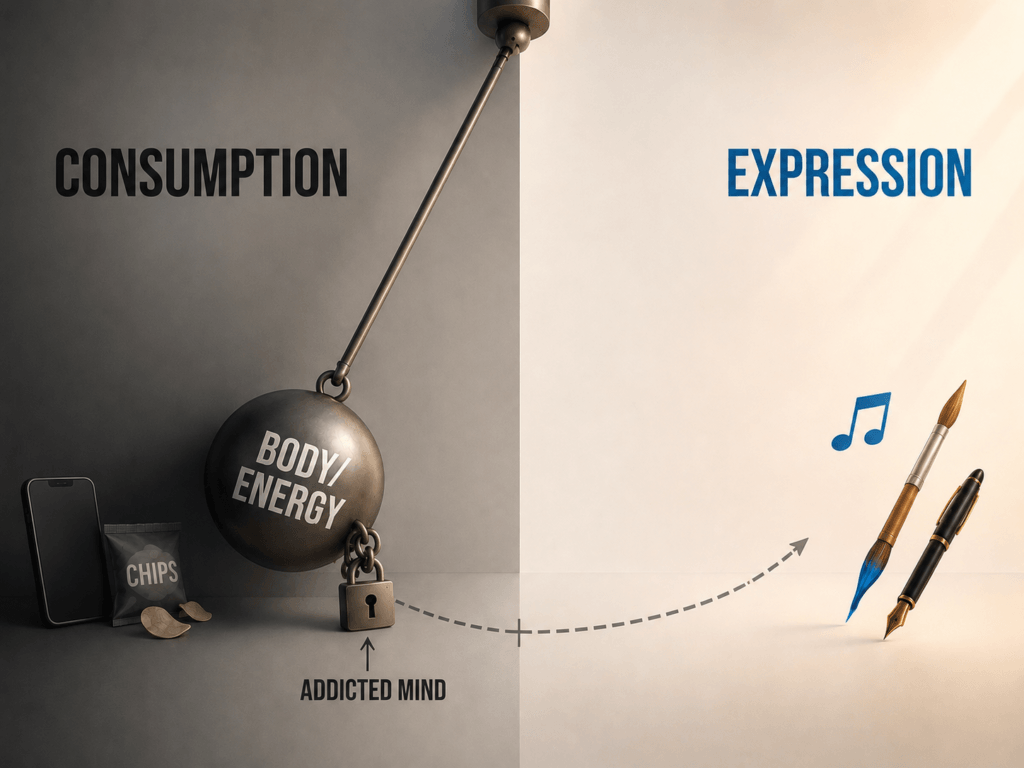
If you look at the pendulum picture again, you will see that the pendulum desperately wants to swing back to the other side. If you break the lock, it will naturally move to expression. That is how you are; life is already trying to go towards expression; you just have to let it. The lock of addiction is very small compared to the life that is alive in you. It does not matter how deep your addiction to consumption is right now; it is completely possible to break free from it. Not through sheer force or brutal willpower, but through awareness, simple everyday actions, a bit of acceptance, and a bit of push. It might not happen today, and it might not happen in a few weeks, but it will happen if you give it attention and time.
Finally, don’t try to just consume this post. Find a way to experience it.
Leave a Reply